

Reverse Proxy vs API Gateway helps you understand how to manage traffic, secure services, and control APIs effectively. Many users feel confused when comparing reverse proxy vs API gateway because both sit between users and backend services.
They may look similar, but they solve different problems. A reverse proxy improves performance and protects servers, while an API gateway focuses on API control and security. In this article, you will learn how each works, who it is for, and what benefits it brings so you can choose the right solution.
What a Reverse Proxy Does Best
A reverse proxy works like a protective layer and traffic manager for your backend servers. It receives requests from users and decides which internal server should handle them.
This setup helps hide your real server IP addresses, which improves security. If you want a deeper understanding of how a reverse proxy server works in real systems, it helps clarify why it is widely used at the infrastructure level.
We use reverse proxies mainly to improve performance and stability. It handles tasks like SSL encryption and caching, so backend servers can focus on processing requests. It also balances traffic across multiple servers, helping prevent overload when many users access your system at the same time.
What an API Gateway Adds on Top
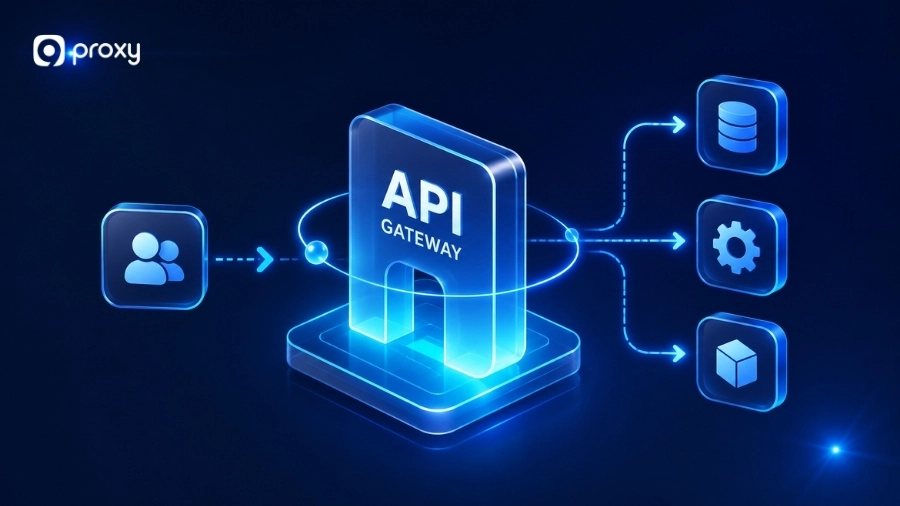
An API gateway builds on the basic functions of a proxy but adds a smarter layer for managing APIs. It can handle traffic, but its main strength is understanding and controlling API requests.
It acts as a central entry point, making it easier for web or mobile apps to connect with multiple backend services. To better understand positioning, some teams also compare proxy server vs reverse proxy when designing their architecture.
At 9Proxy, we see the API gateway as a control tool. It includes features like rate limiting to prevent users from overloading the system. It also manages authentication and can translate requests between different formats, helping services communicate more smoothly. Many organizations that deploy an api proxy later expand to an API gateway when they need broader governance and service management features.
Reverse Proxy vs API Gateway: Side-by-Side Comparison
Choosing between tools becomes easier when you compare them directly. In Reverse Proxy vs API Gateway, a reverse proxy focuses on how traffic is handled, while an API gateway focuses on what data is sent and who can access it.
The table below shows the main differences in Reverse Proxy vs API Gateway. It helps you quickly see which option fits your system and technical needs.
| Feature | Reverse Proxy | API Gateway |
| Relationship | General tool for handling web traffic | A specialized type of reverse proxy with API management features |
| Scope | Does not analyze request content | Understands and processes each API request |
| Security Focus | Protects servers: hides IP, SSL, blocks attacks | Protects APIs: authentication, authorization, policy control |
| Traffic Control | Load balancing, caching, routing | Rate limiting, quotas, request transformation |
| Protocols | HTTP/HTTPS, TCP/UDP, WebSocket | REST, gRPC, SOAP, supports protocol conversion |
| Scalability | High for general web traffic | High for APIs and microservices |
| Complexity | Simpler to start, harder at large scale | More complex due to advanced features |
| Tools | Nginx, Apache, HAProxy | Kong, AWS API Gateway, Apigee |
| Use Case | Optimize traffic, protect servers | Manage APIs and microservices |
In short, use a reverse proxy to protect and optimize websites, and choose an API gateway when you need to manage APIs and complex service systems.
Primary Purpose
In Reverse Proxy vs API Gateway, the main purpose is the biggest difference. A reverse proxy is designed to keep servers safe and improve performance. It handles general web traffic and ensures requests are delivered efficiently to backend systems.
An API gateway is more specialized. It focuses on managing APIs by providing a structured way to expose services. It helps developers organize, control, and even monetize APIs without showing the complexity of the internal system.
Security Role
Security works at different levels in Reverse Proxy vs API Gateway. A reverse proxy provides perimeter security. It acts like a firewall, handles SSL encryption, and protects servers from direct access.
An API gateway adds deeper security. It checks user identity and permissions before allowing access to specific APIs. It often connects with identity systems to make sure every request is verified and controlled. This becomes especially important when implementing rest api proxy authentication across multiple services and environments.
Traffic Control and Performance
In Reverse Proxy vs API Gateway, performance and control are handled differently. A reverse proxy improves speed by caching content and reducing server workload. This helps websites load faster and handle more users. In larger systems, it often works together with other components, so comparing load balancer vs reverse proxy can help you design better traffic distribution.
An API gateway focuses on controlling usage. It sets limits such as how many requests a user can make. This helps prevent system overload, control costs, and stop misuse of APIs. Teams that need both infrastructure optimization and API governance often evaluate api proxy vs api gateway to determine which layer should handle specific traffic management tasks.

Protocol and Data Handling
Data handling is another key difference in Reverse Proxy vs API Gateway. A reverse proxy mainly forwards requests using standard protocols like HTTP or HTTPS without changing the data.
An API gateway is more flexible. It can modify requests and responses, and even convert between different protocols. This allows different systems to work together without changing the backend. It can also simplify tasks such as proxy api versioning, helping teams introduce new API releases without disrupting existing consumers.
Complexity and Scalability
In Reverse Proxy vs API Gateway, complexity depends on functionality. Reverse proxies are simpler because they focus on basic traffic handling. They are easier to set up and scale for most web applications.
API gateways are more complex because they include many features like authentication, policies, and transformations. They are powerful for large systems, but require more setup, maintenance, and technical knowledge to run effectively.

Which One Should You Use?
Choosing between Reverse Proxy vs API Gateway does not have to be complicated. It mainly depends on the type of traffic you are handling. By understanding your system needs and future growth, you can make a more practical and cost-effective decision.
When a Reverse Proxy Is Enough
You do not always need advanced features. In many situations, a reverse proxy is the simpler and more cost-effective solution, especially for smaller or less complex systems.
- You are running a standard website or a single web application with predictable traffic
- Your main goal is load balancing and hiding your server’s IP from public access
- You want to improve speed using basic caching without adding too much complexity
- You have a limited budget and prefer lightweight tools like Nginx or HAProxy
- You want a quick setup that is easy to maintain over time
When an API Gateway Is the Better Choice
As your system grows, you may need more control, security, and flexibility. This is where an API gateway becomes a better and more scalable option.
- You are working with a microservices architecture that includes many connected services
- You need to control access for different users, partners, or customer groups
- You want to monitor API usage for analytics, reporting, or billing purposes
- You need to limit requests to prevent overload and ensure fair usage (rate limiting)
- You require consistent policies across multiple APIs and services
When Using Both Is the Smartest Choice
Many professional systems use both tools together to build a stronger and more flexible setup. A reverse proxy can sit at the edge of the network to handle web traffic, SSL, and basic protection. Behind it, an API gateway can manage API-specific tasks such as authentication, rate limiting, and request control.
This combination gives you the benefits of both. The reverse proxy improves speed and protects infrastructure, while the API gateway adds deeper control over how services are accessed and used. In larger deployments, architects frequently compare load balancer vs reverse proxy configurations before deciding how traffic should move through each layer.

Reverse Proxy vs API Gateway: Benefits and Drawbacks Breakdown
Every tool has its trade-offs. We have listed the honest pros and cons below to help you understand the long-term impact of your choice.
This table compares the benefits and drawbacks of Reverse Proxy vs API Gateway in a real-world environment. Understanding these limits helps you avoid technical debt as your application scales.
| Benefits / Drawbacks | Reverse Proxy | API Gateway |
| Benefits | The setup process is simple, easy to deploy, and maintain | Strong API control, supports authentication and authorization |
| Improves speed with low latency | Rate limiting, detailed monitoring | |
| Hides backend servers | Request transformation | |
| Cost-effective | Better for microservices | |
| Drawbacks | Limited API-level control | More complex to set up and manage |
| Limited analytics and governance | May add latency if not optimized | |
| Basic security features, not suitable for complex API ecosystems | Requires higher cost, more resources, and maintenance |
In summary, reverse proxies are efficient and simple, while API gateways provide deeper control but require more effort to manage.
Common Mistakes When Choosing Between Them
One of the most common mistakes in Reverse Proxy vs API Gateway is over-engineering. Many teams choose a complex API gateway too early, even when a simple reverse proxy could solve the problem faster and at lower cost. This often leads to unnecessary complexity without real benefits. Here are key mistakes to avoid:
- Choosing an API gateway when a reverse proxy is enough for simple traffic needs
- Ignoring the risk of a single point of failure, which can take down your entire system
- Not setting up backup or redundancy for your proxy or gateway
- Assuming a reverse proxy alone provides enough security for public APIs
- Overlooking the need for proper authentication and access control in modern systems
- Not understanding when a VPN might be more appropriate for secure access, which is why some teams also evaluate VPN vs reverse proxy for internal systems
Avoiding these issues helps you build a system that is both efficient and reliable.

Conclusion
Understanding the difference between Reverse Proxy vs API Gateway helps you build a modern and scalable system. Reverse proxies are ideal for optimizing web traffic and protecting servers, while API gateways are better for managing multiple services and controlling access to data.
We recommend starting with a reverse proxy for simple setups, then adding an API gateway as your system grows. If you want to explore more architecture guides and infrastructure comparisons, Blog9Proxy provides detailed resources for developers, system administrators, and engineering teams.
For better performance and security, you can also integrate high-quality proxies from 9Proxy. Choosing the right Reverse Proxy vs API Gateway setup early can save you time and effort later.