


Can proxy servers be detected? Yes, but it is rarely a simple yes-or-no situation. Proxy users often need clear insight into how detection works, how it impacts performance, and how to reduce risks with smarter setups.
In this 9Proxy blog, we will explain how websites rely on technical signals, behavioral patterns, and IP reputation rather than a clear proxy label. By understanding why some setups fail and how detection systems operate, you can improve connection stability, stay under the radar, and use proxies more efficiently and reliably.

Quick Answers: Can Proxy Servers Be Detected or Not
Yes, can proxy servers be detected is a question with a clear answer: in many cases, they can. Websites, apps, and anti-bot systems do not rely on a simple “proxy flag.” Instead, they look at patterns, technical signals, and user behavior to estimate whether a connection is using a proxy.
However, detection does not mean full identification. Most systems only make a guess based on probability, not certainty. You may see a CAPTCHA, face limited access, or even get blocked, but the website does not always know your real identity behind the proxy.
For users comparing privacy tools, the difference between proxies and VPNs matters because each tool exposes different network signals. You can read our guide on proxy vs vpn to choose the right solution for your needs.
Detection Is Based On Probability, Not Certainty
Websites do not always have a clear way to confirm you are using a proxy. Instead, they use something called a risk score, which is an estimate of how likely your connection is hidden or automated. If your technical signals look unusual, this score goes up.
When the score becomes too high, several things can happen:
- Soft blocks: You may see more CAPTCHA or “Access Denied” messages
- Hard bans: The website blocks the IP address completely
- False positives: Normal users, such as those on public Wi-Fi or company networks, can sometimes be flagged by mistake
Some Proxies Are Easier To Detect Than Others
The type of IP you choose determines your baseline detection risk. Some setups act as a giant red flag, while others blend into the background of normal internet traffic seamlessly.
Understanding the hierarchy of risk is essential:
- Datacenter Proxies: These are the easiest to detect because their IPs belong to known hosting providers like AWS or DigitalOcean.
- Residential Proxies: These are harder to spot since they use IPs assigned by ISPs to real homes. If you want a clearer definition of what is a residential proxy, our full guide explains why residential IPs are widely used for lower detection risk.
- Mobile Proxies: These offer the lowest risk because they share IPs with thousands of real mobile users.
- Configuration Errors: Even a mobile proxy can be caught if your browser settings do not match your IP location.

What Websites Actually See When You Use A Proxy
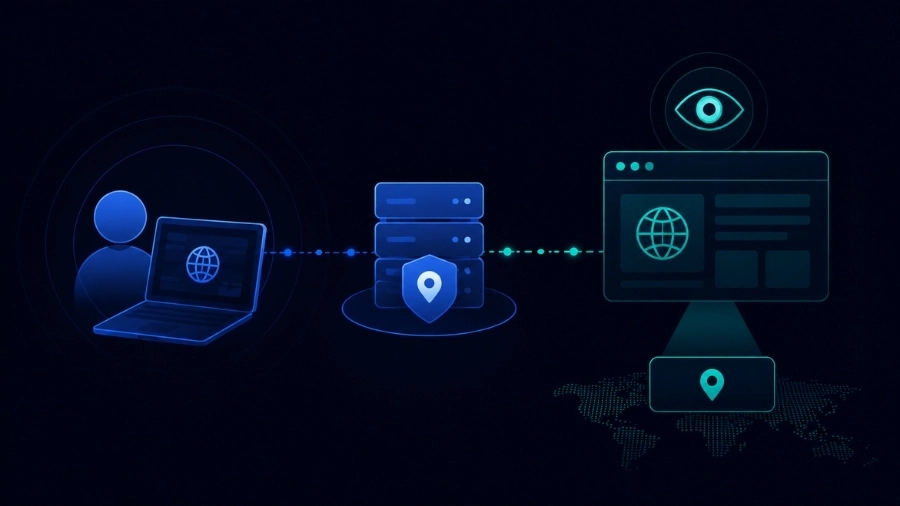
When you visit a site, the server receives a packet of data that contains more than just an IP address. While a proxy masks your origin, websites still collect various metadata to build a profile of who you might be.
The following table breaks down how can proxy servers be detected and connects the basic idea of what is a proxy server with the signals that remain visible to the server. You should view this table to understand the difference between what you hide and what you inadvertently reveal.
| Data Category | What Websites See | Accuracy | Mitigation |
| IP Address | Proxy IP + blacklist checks | 70 – 95% | Use residential IP, rotate |
| ISP/ASN | Datacenter vs residential network | ~100% | Use diverse residential ASN |
| Geolocation | IP vs browser mismatch | ~100% | Keep all signals consistent |
| TLS Fingerprint | TLS pattern vs real browser | 85 – 96% | Mimic a real browser TLS |
| Headers | Browser info consistency | ~80 – 85% | Sync headers properly |
| WebRTC | Possible real IP leak | 100% | Disable/spoof WebRTC |
| Behavior | User actions & patterns | 92 – 98% | Act like real users |
In simple terms, a proxy changes your visible IP address, but websites still check other signals to see if your behavior matches that location.
Visible Data
Websites mainly see the proxy’s IP address, its approximate location, and the network provider (ASN). When you use a proxy, you replace your real identity with the proxy’s identity.
However, if that ASN belongs to a data center or a known hosting network, websites can quickly recognize datacenter proxies instead of typical residential users, which increases detection risk.
Hidden But Inferred Signals
Beyond visible data, websites also analyze behavior and fingerprinting to estimate your identity. They look at several signals, such as:
- Browser fingerprint
- Session consistency
- Navigation behavior
Even if your real IP is hidden, these signals can still link your activity across sessions. For example, if your browser shows “Germany” but your IP appears in the USA, the mismatch raises suspicion and increases detection risk.
Why Even a Good Proxy Can Still Get Detected
You might wonder why a high-quality proxy still gets blocked. While quality helps a lot, it is not a complete solution against all tracking and security systems. Common reasons for detection include:
Bad neighborhoods
Even if your IP looks clean, it may belong to a subnet where other users have performed suspicious or abusive actions in the past. As a result, the entire IP range can be marked as risky, and your connection may be affected even if you did nothing wrong.
Session inconsistency
If your IP address changes during important activities such as logging in, making payments, or completing a checkout, the system may see this as unusual behavior. This inconsistency often triggers fraud prevention systems and leads to verification requests or blocks.
Aggressive security systems
Large platforms like Google or Amazon use advanced anti-fraud technologies. These systems analyze many signals at once and can detect even small mismatches, such as differences between your IP location and browser settings, or unnatural browsing behavior.
At the same time, many users also ask whether using proxies is allowed in the first place. If you are unsure, it is worth reviewing this guide on are proxies legal to better understand compliance and safe usage.

How Do Websites Detect Proxy Servers In Practice?
Modern detection systems are multifaceted, combining several layers of analysis to catch masked connections. They rarely rely on a single factor, choosing instead to cross-reference your IP data with your technical environment and physical behavior.
This table details the common mechanisms used to answer the question: can proxy servers be detected? Reviewing these methods will help you identify the weak points in your current browsing or scraping setup.
| Detection Method | How It Works | Risk Level |
| IP Reputation | Checks past activity of IP | High |
| ASN Detection | Identifies hosting providers | High |
| Behavior Analysis | Tracks user actions | Medium – High |
| Fingerprinting | Matches device identity | High |
| Header Inspection | Detects proxy headers | Medium |
| Leak Detection | Finds real IP leaks | High |
Websites use these tools in real-time to decide whether to trust your connection, making a multi-layered defense necessary for any serious project.
IP-Based Detection (Reputation, ASN, Blacklist)
Websites rely on IP reputation systems that store large databases of risky or previously abused IPs. If your proxy IP was used for spam, scraping, or bot activity before, it may already be blacklisted.
In addition, websites check the ASN (network provider) to determine whether the IP comes from a residential ISP or a datacenter, which helps them quickly evaluate the trust level of the connection.
Behavior Analysis And Traffic Patterns
Websites also monitor how users interact with pages. Real users behave naturally with varied timing and actions, while automated traffic often appears fast and repetitive. For example, sending too many requests within a short period can raise suspicion. Even if your IP looks residential, unnatural behavior can still trigger detection systems.
Fingerprinting And Environment Mismatch
Your browser shares details such as screen resolution, operating system, installed fonts, and device type. If your IP location does not match your browser settings, such as timezone or language, it creates a mismatch. These inconsistencies make it easier for websites to detect unusual or suspicious activity.
Connection Leaks And Technical Signals
Technical issues like WebRTC or DNS leaks can expose your real IP address or location even when a proxy is active. These leaks often happen due to improper setup or missing configurations.
That is why it is important to test your connection carefully and fix any leaks before performing sensitive or large-scale tasks.
How To Reduce Proxy Detection Risk Effectively
Reducing detection risk is about blending in and behaving like a normal, everyday internet user. The goal is to avoid any unusual signals that could increase your risk score and attract attention from detection systems. To stay safer when using proxies, you can follow these practical strategies:
- Use high-quality residential proxies: Choose IPs provided by real ISPs so your connection looks like a regular home user instead of a datacenter
- Match your fingerprint: Make sure your browser settings, such as timezone and language, align with the proxy’s location to avoid mismatches
- Simulate human behavior: Add natural delays between actions, scroll normally, and avoid performing tasks too quickly or repeatedly
- Use sticky sessions: Keep the same IP during important tasks to prevent sudden location changes that may look suspicious
- Check for leaks: Regularly test for WebRTC and DNS leaks to ensure your real IP or location is not exposed

Can Proxies Ever Be Completely Undetectable?
The short answer is no. No proxy can guarantee 100% undetectable usage. Detection systems are always improving, using AI, smarter pattern analysis, and larger global databases to identify unusual activity. This means staying anonymous is not a one-time setup, but an ongoing process.
Instead of searching for a “perfect” invisible solution, it is better to focus on reducing risk. When you combine a high-quality residential proxy with proper browser settings and natural user behavior, you make detection much harder. In most cases, this level of setup is enough to avoid being flagged by typical websites.
Use High-Quality Residential Proxies To Reduce Detection Risk With 9Proxy
At 9Proxy, we provide the infrastructure you need to maintain a high trust score. Our network consists of over 20 million real residential IPs across 90+ countries. Because these are genuine IPs from real households, they carry the highest level of trust and the lowest detection rates in the industry.
We offer granular targeting down to the city and ISP level, ensuring your digital footprint remains consistent and local. Whether you are performing web scraping or managing multiple social accounts, 9Proxy provides the stability you need.
For SEO research, a dedicated proxy for seo ranking setup can keep sessions, locations, and data collection workflows more consistent.
Key Advantages of 9Proxy:
- 100% Real Residential Proxies: Sourced from real users, never data centers.
- 99.95% Uptime: We ensure your tasks run smoothly without constant interruptions.
- Unlimited Bandwidth: Available with our IP-based packages, perfect for heavy data tasks.
- Flexible Pricing: Start from $0.015/IP with IP package or $0.68/GB with GB packages.
- Crypto Perks: Get a 5% bonus in IPs when you pay with cryptocurrency.
FAQs
Can all proxy servers be detected?
No. Whether proxies are detected depends on the proxy type, how it is configured, and how it is used. Some proxies are more difficult to detect than others, but none are completely invisible in every situation.
Why would someone want to detect a proxy server?
Websites try to detect proxies to protect their systems. This helps them prevent abuse, block unwanted traffic, enforce location-based restrictions, and make sure services are used fairly by real users.
Are there any secure and undetectable proxy servers?
No proxy can guarantee full invisibility. However, using high-quality residential proxies with the right setup and consistent behavior can greatly reduce the chance of being detected.
Conclusion
Understanding can proxy servers be detected is the first step to improving your online privacy and running stable automation tasks. By choosing the right IP type, keeping your browser fingerprint consistent, and avoiding unnatural behavior, you can greatly reduce the chance of being blocked.
9Proxy recommends focusing on quality over cost to maintain long-term performance. For more practical proxy learning, visit Blog9Proxy and keep this guide close whenever proxy detection issues appear. A reliable setup helps your projects run smoothly without interruptions.