

Residential vs mobile proxy is a common comparison for users who want to avoid blocks and improve online performance. If you are struggling to choose the right option, this guide helps you understand the key differences, real use cases, and how each proxy type works in practice. Many users get confused because both can hide IPs and bypass restrictions, but they serve different purposes.
Choosing the wrong one can lead to blocked requests, wasted budget, or account issues. 9Proxy will show you how to select the best solution to reduce risk, improve efficiency, and optimize your workflow.
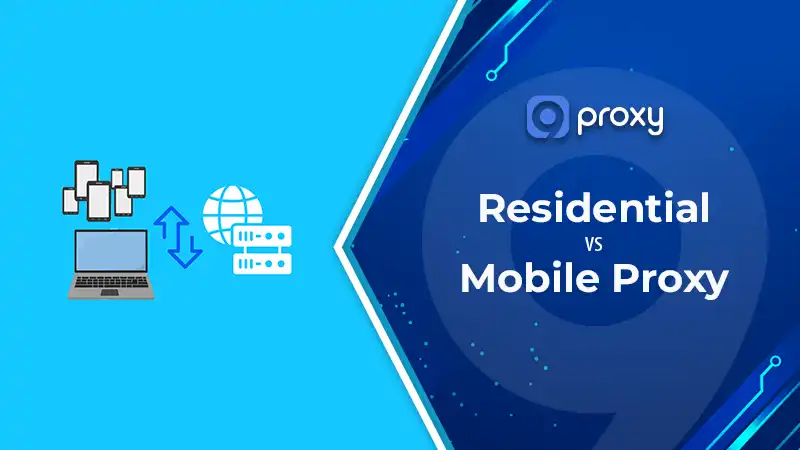
Residential vs Mobile Proxy: The 6 Differences That Matter Most
Residential vs mobile proxy comparison depends on factors like IP source, detection risk, speed, GEO accuracy, cost, and scalability. This table summarizes all key differences so you can quickly understand which proxy fits your needs.
| Factor | Residential Proxy | Mobile Proxy |
| IP Source | Home ISP networks | Mobile carrier networks |
| Detection Risk | Low | Very low |
| Speed | Stable | Variable |
| GEO Targeting | City-level precision | Carrier-based location |
| Cost | Moderate | High |
| Scalability | Large IP pool | Limited pool |
| Best Use | Data scraping, SEO | Social media, apps |
| Session Type | Flexible | Often rotating |
| Stability | High | Medium |
| Availability | Widely available | Limited regions |
Residential proxies are more scalable and cost-efficient for large automation tasks. Many businesses comparing datacenter proxies vs residential eventually choose residential networks when they need better trust scores without paying mobile proxy pricing.
IP Source And Network Type
Residential proxies send your traffic through real home internet connections provided by ISPs, such as fiber or cable. Mobile proxies, in contrast, route your requests through real mobile devices using cellular networks like 4G, 5G, or LTE. If you want a deeper explanation of how a residential proxy works in real-world environments, the ISP structure behind residential networks plays a major role in how websites evaluate trust.
Detection Risk And Trust Level
Mobile proxies are very hard to detect because they behave like real smartphone users. Websites rarely block mobile IPs since that could affect real customers. Residential proxies are also trusted, but they can sometimes be flagged if the activity looks unusual. For high-security platforms like Instagram, mobile proxies are usually the safer option.
Speed And Connection Stability
Residential proxies often provide more stable and consistent speeds because they rely on fixed home internet connections. Mobile proxies can have speed changes due to network congestion, signal strength, or switching between towers. Some users also compare mobile infrastructure with traditional ISP-based systems through resources like isp vs residential proxies when evaluating long-session stability.
Geo-Targeting Precision
When comparing residential vs mobile proxy, GEO targeting plays an important role. Residential proxies offer more precise location targeting. Here’s how they differ:
- Residential proxies allow targeting by country, city, or even ISP
- Mobile proxies often provide broader targeting based on carrier networks
- Residential proxies are better for local SEO and pricing checks
This makes residential proxies more suitable for tasks that require exact location accuracy.
Cost And Pricing Model
Mobile proxies are generally more expensive because they require complex infrastructure from mobile networks. Residential proxies are more affordable and better for large-scale use. If you need to process a lot of data, residential proxies offer better value. Mobile proxies are better for smaller, high-security tasks.
Scale And Availability
Residential proxy networks usually have millions of IPs, making them suitable for large-scale projects like scraping many pages. Mobile proxy pools are smaller and more limited, which can make scaling harder. We recommend using residential proxies for bulk tasks and saving mobile proxies for sensitive or high-risk targets.
Choosing the Right Proxy Based on Your Use Case
Using a residential vs mobile proxy incorrectly can result in account flags or wasted resources. We suggest residential proxies for high-volume data collection and mobile proxies for high-security targets like Instagram or TikTok. Follow these two main scenarios to protect your investment:
Best Scenarios for Residential Proxies
Choose residential proxies if you need to scan thousands of pages, check global prices, or perform general web research at scale.
- Market Research: Access localized versions of websites to view accurate pricing and offers from different regions
- Brand Protection: Scan large parts of the web to detect counterfeit products or unauthorized usage
- SEO Monitoring: Check search engine rankings from many cities to track changes in SERPs
- Content Access: View geo-restricted content and access region-specific websites safely
Best Scenarios for Mobile Proxies
Mobile proxies are better for sensitive platforms that require high trust because they simulate real mobile users. Businesses that rely heavily on app-based traffic often use a dedicated mobile proxy server setup to mimic realistic carrier behavior across different devices and locations. Here are typical use cases:
- Social Media Management: Manage multiple accounts safely without triggering platform detection. Many automation teams combine mobile proxies with a dedicated social media proxy workflow to reduce account restrictions on platforms like Instagram or TikTok.
- Ad Verification: Check how ads appear on real mobile devices across different regions
- App Testing: Test applications on real 4G/5G mobile networks
- High-security platforms: Avoid detection on strict systems with advanced security
We recommend mobile proxies when stealth is more important than scale.
Mistakes People Make When Choosing Between Residential vs Mobile Proxy
Many users choose the wrong proxy type because they focus on price instead of real-world security requirements. These mistakes can lead to higher long-term costs, frequent blocks, or poor data quality. Understanding the difference between residential vs mobile proxy helps you avoid these issues and choose the right solution from the start.
Choosing Based On Price Alone
Low-cost proxies may look attractive, but they are rarely the best option for high-security tasks.
- Cheap proxies often suffer from high failure rates or “dirty” IPs.
- Mobile proxies are expensive but offer the stealth needed for sensitive accounts.
- Residential proxies are more budget-friendly for general tasks.
- Using the wrong type often leads to failed projects, increasing costs over time.
In the residential vs mobile proxy decision, choosing based only on price can lead to failed campaigns and higher costs over time.
Ignoring The Target Site’s Detection Level
Not all websites have the same level of security. Some platforms are much stricter than others. Social media platforms use advanced detection systems and often prefer mobile traffic patterns. In these cases, mobile proxies are more effective. Meanwhile, many e-commerce sites or blogs only require residential proxies to bypass basic limits. Teams running large-scale product monitoring often rely on an ecommerce proxy environment because residential traffic usually provides enough legitimacy without the higher cost of mobile networks.
To succeed in residential vs mobile proxy selection, you must match the proxy type with the difficulty level of the target website.
Using Mobile Proxies For Bulk Jobs That Need Scale
Mobile proxies are not designed for large-scale operations. Their cost per GB is high, which makes them unsuitable for heavy data tasks. Teams running large campaign validation or proxies for affiliate testing usually prioritize residential networks because they scale more efficiently across thousands of sessions. Here’s what to consider:
- Mobile proxies cost more per GB
- Not suitable for scraping large datasets
- Residential proxies provide better scalability
- Wrong usage wastes budget
This is a key point in the residential vs mobile proxy comparison: choose mobile for security, and residential for scale.
Using Residential Proxies For High-Risk Mobile Platforms
Residential proxies are reliable, but they are not always enough for strict mobile platforms. Apps like Instagram or TikTok trust mobile network traffic more than home ISP traffic. This means residential IPs may still get flagged or blocked in some cases. If you experience frequent bans, switching to mobile proxies is the safer option.
Understanding this difference is critical when comparing residential vs mobile proxy for sensitive environments.
Forgetting About Session Type And Rotation
Your setup is just as important as the proxy type you choose. Sticky sessions are useful for maintaining logins, while rotating IPs helps avoid detection during scraping. However, incorrect rotation settings can cause problems. Rotating too often may break sessions, while rotating too slowly can lead to blocking.
To get the best results in residential vs mobile proxy usage, always configure your sessions and rotation settings correctly based on your task and provider guidelines.
Do You Ever Need Both Proxy Types?
For many professional workflows, using both proxy types together is often the best strategy. You can rely on mobile proxies for sensitive tasks like account management, where security and trust are the top priorities. At the same time, you can use residential proxies for large-scale data collection or research, where you need high volume at a lower cost.
This combined approach helps you balance performance and budget. You avoid overspending on expensive mobile traffic while still protecting critical accounts. Many hybrid proxy workflows used by providers like 9Proxy also separate mobile traffic for account-sensitive actions while routing bulk requests through residential pools.
Conclusion
Choosing between a residential vs mobile proxy depends on your specific needs: choose mobile for high-security social media tasks and residential for large-scale data collection. Understanding these differences prevents bans and keeps your projects running efficiently. You can also explore more proxy comparisons and deployment strategies through Blog9Proxy when building a long-term proxy workflow.
For reliable, high-performance needs, explore our premium residential proxy pools here at 9Proxy, designed to give you the speed and success rate you need for every residential vs mobile proxy decision.